
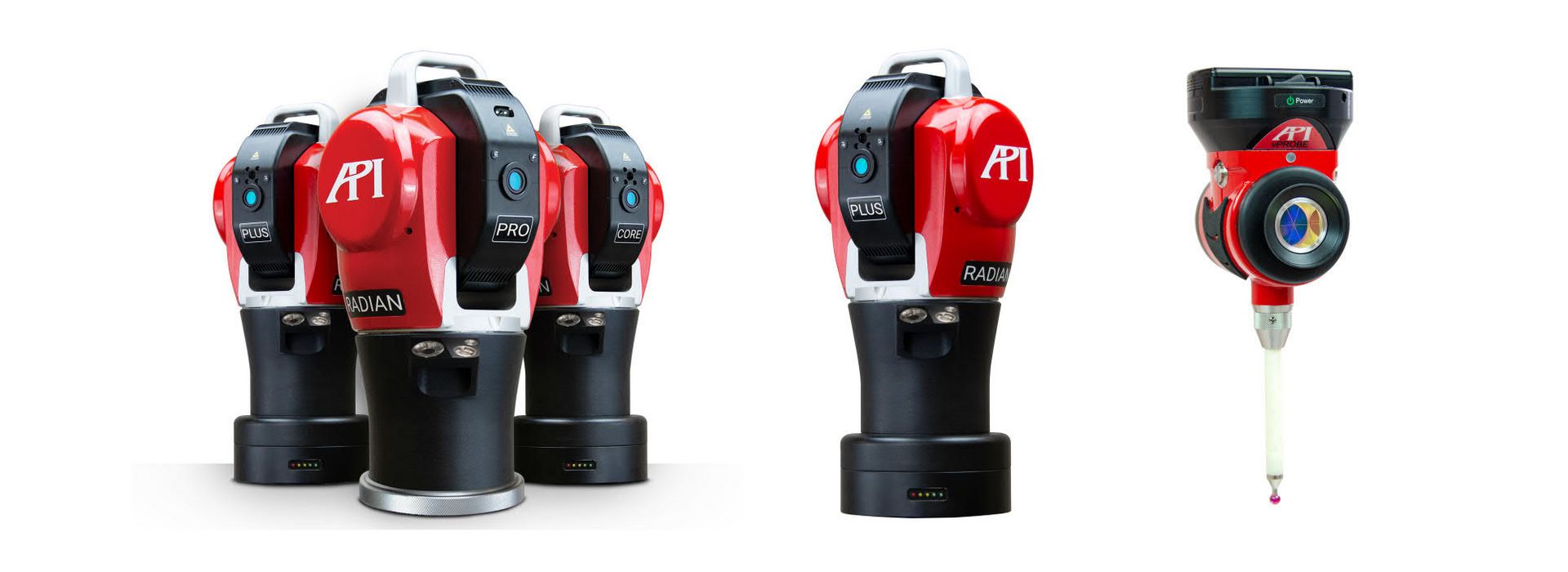
Laser Tracker
Laser trackers represent the benchmark for accuracy and reliability in portable coordinate measuring technology. They are ideally suited for the precise measurement of large measurement volumes and are among the most versatile and mobile tools used by our metrology specialists.
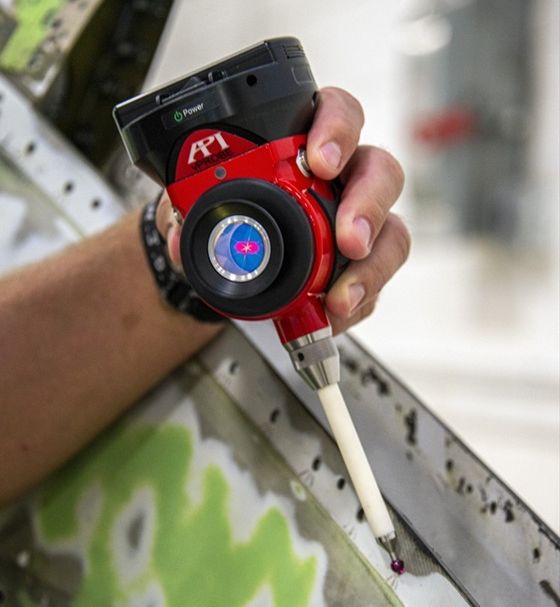
Laser trackers enable highly accurate 3D measurements to reflectors. In combination with 6DoF functionality, they also allow the use of handheld probes and laser scanners. This results in an almost unlimited range of applications – from form and position measurements to surface inspection and the measurement of moving objects.
MEASUREMENT VOLUME & ACCURACY
The measurement volume depends on the specific device and typically ranges from just a few meters up to 80 meters. Using specialized measurement strategies, this volume can be extended almost arbitrarily.
Typical accuracy values are:
- 0.03 mm within 5 m
- 0.09 mm within 20 m
- 0.35 mm within 80 m
This level of precision makes laser trackers an essential tool wherever maximum accuracy and reliability are required.
SETUP & MEASUREMENT SPEED
Laser trackers can be used in a horizontal position or mounted in virtually any orientation. They achieve measurement rates of up to 1,000 points per second, allowing moving targets to be tracked or large surfaces to be measured in the shortest possible time – without compromising accuracy.
HOW IT WORKS
The operating principle of a laser tracker is comparable to that of a traditional total station, but with significantly higher distance measurement accuracy and measurement speed.
A laser beam is emitted in a defined spatial direction and reflected back to the tracker by a reflector. The distance between the tracker and the reflector is calculated based on the beam’s travel time. Two high-precision angular encoders in the tracker head determine the direction of the laser beam. Combined with the distance measurement, this results in precise 3D coordinates of the reflector.
By referencing defined geometric features of the measured object, the internal coordinate system of the tracker can be transformed accordingly. This enables:
- comparative measurements
- direct evaluation of form, position, and alignment
- precise positioning and alignment of components
- layout tasks such as axis alignment or marking features and reference lines
Modern laser trackers are equipped with advanced 6DoF systems, allowing not only the determination of the reflector’s position but also its spatial orientation. This enables accurate measurements using handheld probes and laser scanners and significantly expands the range of possible applications.